
If someone in your family has been drinking more as the holidays get closer, you do not need a perfect speech to start the conversation. A short, calm talk that names what you have noticed and offers a next step is enough. You can call for information even if they are not ready.
Quick answer
Name the change you have seen. Skip labels and ultimatums on the first conversation. Offer to help them look at options. You do not have to manage the next step alone.
What to say (and what to skip)
Start with what you have observed. “I have noticed you have been drinking more in the evenings” is clearer than “You have a problem.” The first sentence is about the change. The second sentence can be about the effect: “I am worried about how the mornings are going.”
Skip the labels on the first conversation. Words like alcoholic or intervention can shut the talk down before it starts. Skip the ultimatum. “If you do not stop I am leaving” is a different conversation and usually comes later, if it comes at all.
Offer a next step instead of a demand. “Would you be willing to talk to someone about it?” or “I can call and ask what an assessment looks like” keeps the door open. You are not asking them to decide the level of care. You are asking if they will take one step.
When the conversation is more useful
Pick a calm moment. The middle of a holiday dinner is not that moment. One person is better than a group. A group can feel like an ambush even when everyone means well.
The conversation can be short. Five or ten minutes is enough to name what you have seen and ask if they will talk to someone. You do not need to cover the whole history in one sitting.
What if they say no
They may say they are fine. They may say they will cut back after the holidays. Both answers are common. You can still call for information. The assessment itself requires the person who may need treatment. You cannot complete it for them. You can learn what the options are so you are ready if they change their mind.
You do not have to manage the next step alone. Mind Dynamics in Plainville offers family support alongside outpatient detox, PHP, and IOP. You can call and ask what an assessment looks like and what family members can and cannot do.
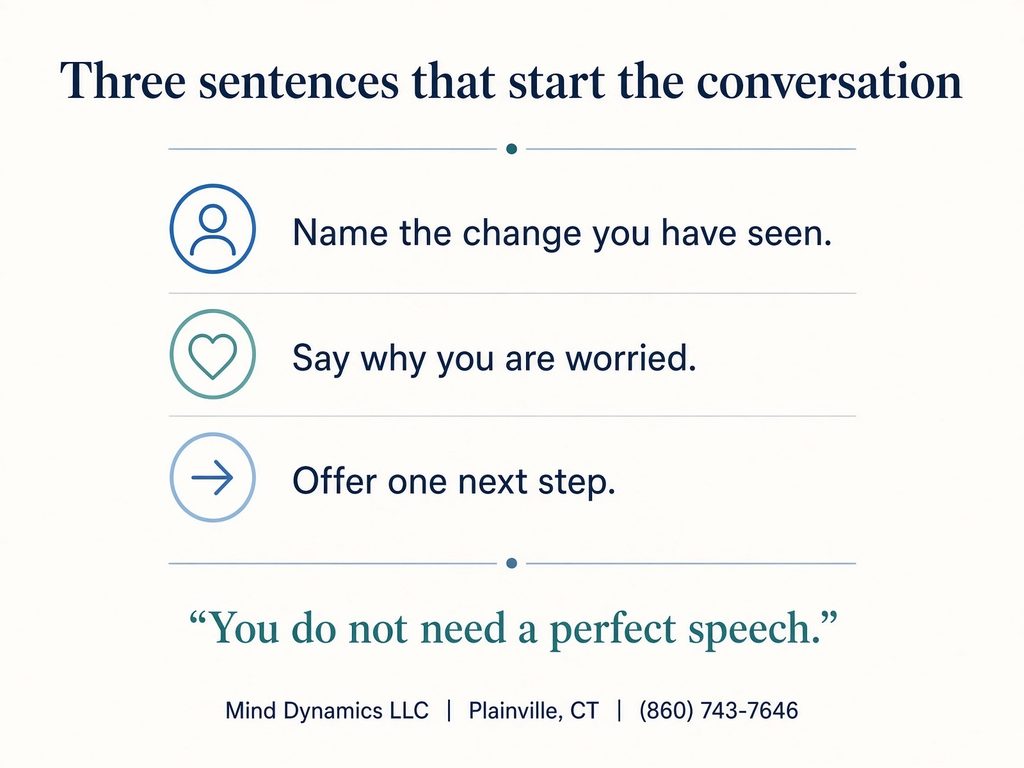
What you can prepare before the conversation
You do not need a script. These points can help:
- One or two specific changes you have noticed
- One sentence about why you are worried
- One offer of a next step
- The phone number of a place they can call if they are willing
You can write the points down. You do not have to read them. The goal is to keep the conversation short and clear.
What happens if they agree to talk to someone
If they say yes, the next step is an assessment. The assessment looks at substance use, health, withdrawal risk, mental health, and support at home. The recommendation is based on clinical needs and safety, not preference. You can sit in if they want you there. The clinical conversation is with them.
You can read more about what the assessment covers on the page about what happens during an assessment once it is live, and about family support on the family program page.
Local note for Hartford County
If you live in Plainville, Hartford, Bristol, Farmington, New Britain, Southington, Newington, or Simsbury, you can reach Mind Dynamics for information. Call (860) 743-7646. You can call before they are ready. You do not need a perfect speech.
Questions people ask
Do I need to wait until after the holidays?
No. You can start the conversation now. Waiting until January is not required.
What if they get angry?
Stop the conversation. You can try again later. You can still call for information in the meantime.
Can I call for them?
You can call for information. The assessment requires the person who may need treatment.
What if I am not sure it is a problem?
You can still call and describe what you have noticed. The team can explain what an assessment looks like.
Call (860) 743-7646 if you want to talk through the next step.
Why the first conversation is usually short
Most families wait because they want the perfect moment and the perfect words. That moment rarely arrives. The drinking continues while the perfect conversation is being planned. A short talk that names one change and offers one next step is more useful than a long speech that never happens.
The first conversation is not the assessment. It is not the treatment plan. It is the step that asks whether the person is willing to talk to someone. Everything after that depends on their answer.
What families in Hartford County often notice
The changes are usually ordinary. More drinks in the evening. A harder time getting up in the morning. Less interest in plans that used to matter. Irritability when someone mentions the drinking. These are the details that can be named without a label.
You do not need to diagnose the problem. You need to describe what you have seen. The clinician can sort the rest during an assessment if the person is willing to go.
How to handle the holidays if the conversation has not happened yet
You can still set a limit for yourself. You do not have to attend every gathering. You do not have to pour the drinks. You do not have to pretend the increase has not happened. Those choices are separate from the conversation. They protect you while you decide when and how to talk.
If the person has already said they will cut back after the holidays, you can ask what that looks like. “What does cutting back mean to you?” is a clearer question than “Are you going to stop?” It keeps the conversation on their plan instead of your demand.
What Mind Dynamics can do for families
Mind Dynamics in Plainville offers family support alongside the clinical programs. You can call and ask what an assessment involves, what family members can and cannot do, and what the next step looks like if the person is willing. The team cannot complete an assessment for someone who is not present. They can give you information so you are not guessing.
The programs available after an assessment include outpatient detox, PHP, and IOP when clinically appropriate. The recommendation comes from the assessment, not from the family conversation. You can read more about the programs on the outpatient treatment page and the family program page.
A simple way to start
You can use these three sentences:
- I have noticed you have been drinking more in the evenings.
- I am worried about how the mornings are going.
- Would you be willing to talk to someone about it?
That is enough for the first conversation. You can stop there. If they ask questions, you can answer what you know and offer to call together. If they say no, you can end the talk and still call for information on your own.
What this article will not do
This article will not tell you how to force the conversation. It will not guarantee that the person will agree. It will not replace the family program page. It gives you a practical way to start and a place to call if you want information before or after the talk.
Call (860) 743-7646.
What to do if the person agrees but then delays
Agreement is not the same as an appointment. They may say yes and then find reasons to wait. You can ask when they want to call. You can offer to sit with them while they make the call. You cannot make the appointment for them. The assessment requires their participation.
If the delay continues past the holiday, you can ask again. One follow-up is usually enough. Repeated pressure often closes the door that the first conversation opened.
What to do if other family members disagree
Not everyone in the family will see the same change. Some will want to wait. Some will want a stronger confrontation. You can still have the short conversation. You do not need the whole family to agree before you speak. You also do not need to convince the people who disagree. The conversation is with the person who has been drinking more.
Insurance and practical details
You do not need to know the insurance details before the first conversation. If the person is willing to talk to someone, the assessment can include a coverage check. If they do not have insurance, say so when you call. The team can still explain the options.
Transportation is another practical detail. If the person is willing to go to an assessment, decide in advance who will drive. Mention any transportation concerns when you call so the team can discuss them.
When the increase is already affecting work or safety
If the drinking is already causing missed work, unsafe driving, or withdrawal symptoms, the conversation can still be short, but the next step should not wait. You can name what you have seen and ask if they will talk to someone this week. You can also call for information on the same day. The assessment is how the team decides whether outpatient care is safe or whether a higher level of care is needed.
Local close
Mind Dynamics LLC in Plainville serves adults from Hartford County, including Hartford, Bristol, Farmington, New Britain, Southington, Newington, Simsbury, and nearby towns. Call (860) 743-7646 to ask what an assessment looks like or to talk through the next step for your family.
Questions worth asking the team when you call
You can ask any of these:
- What does an assessment involve?
- Can a family member sit in?
- What happens if the person is not ready?
- What levels of care are available after the assessment?
- What should I do if the person agrees and then delays?
The team can answer these without the person being present. The answers help you know what is possible before you have the conversation.
If this is the week you have been waiting for
Many families wait for the holidays to end. The drinking does not pause for the calendar. A short conversation now is more useful than a perfect conversation in January. You can call for information today. You can have the talk when the moment is calm. You do not need both to happen on the same day.
Call Mind Dynamics at (860) 743-7646.