
Watching someone you care about struggle with addiction is painful. Watching them refuse help can feel even harder. Many families reach a point where they are scared, exhausted, and unsure what to do next. They want to help, but every attempt seems to create more conflict or more distance.
The truth is that you cannot force most adults into treatment against their will. That does not mean you are powerless. There are practical, evidence-informed ways to support a loved one, protect your own wellbeing, and increase the likelihood that they will eventually accept help.
This article explains what families can do when someone refuses treatment, what usually does not work, how to set boundaries without abandoning the person, and how to prepare for the moment they become more open to support. It is written for families who feel stuck between caring deeply and watching the situation continue without change.
Can You Force Someone Into Addiction Treatment?
In most situations, no. Adults generally cannot be forced into addiction treatment simply because family members want them to go. There are limited legal exceptions in some states involving court-ordered treatment or emergency holds when a person is an immediate danger to themselves or others, but those situations are specific and not available in every case.
Trying to force treatment often increases resistance. People may dig in further, become more secretive, or cut off communication. The more useful question is not how do I make them go, but how do I respond in a way that protects myself and keeps a realistic path to help open.
This shift in focus is important. Families often spend months or years trying to convince, plead, argue, or threaten. Those approaches rarely create lasting motivation. A calmer, more structured response tends to work better over time.
It can also help to accept a difficult truth: readiness belongs to the person struggling. Families can influence the environment around that readiness, but they cannot manufacture it on demand.
Why Someone May Refuse Help
Understanding the reasons behind refusal can reduce frustration and help families respond more effectively. Common reasons include:
Denial or minimization. The person may not see their use as a serious problem, or they may compare themselves to people whose situations appear worse. From the outside the damage may be obvious. From the inside it may still feel manageable or temporary.
Fear of withdrawal. Many people are afraid of the physical and emotional discomfort of stopping. That fear can be stronger than the desire to change, especially if they have experienced withdrawal before or have heard frightening stories about it.
Shame and stigma. Asking for help can feel like admitting failure. Some people would rather continue struggling privately than face the vulnerability of treatment. Shame is often a quieter but powerful barrier.
Loss of control. Treatment can feel like giving up independence. For some, that perceived loss of control is more threatening than continued use. This is especially common for people who highly value self-reliance.
Past negative experiences. Someone who previously attended treatment and relapsed, or who felt judged or poorly supported, may believe help will not work for them. One disappointing experience can shape resistance for years.
Mental health symptoms. Anxiety, depression, trauma, or other untreated conditions can make the idea of change feel overwhelming. When a person is already emotionally overloaded, treatment can feel like one more impossible demand.
Practical concerns. Fear of missing work, losing housing, disrupting family responsibilities, or not being able to afford care can all contribute to refusal. These concerns are not always excuses. Sometimes they are real logistical barriers that need practical answers.
These reasons do not make refusal reasonable in every case, but they do make it understandable. When families respond only with pressure, they often miss the underlying fear or ambivalence driving the resistance.
What Families Should Do
There is no single script that works for every situation. However, certain approaches consistently help families stay grounded and increase the chance of eventual engagement.
1. Take care of your own stability first
Families often put their own wellbeing last. Over time this leads to exhaustion, resentment, and reactive decision making. Getting support for yourself is not selfish. It is necessary. This may include therapy, family support groups, or simply creating more emotional distance from daily chaos. A more stable family member is usually more effective than a depleted one.
2. Educate yourself about addiction and treatment options
Understanding how addiction affects behavior, decision making, and motivation helps families respond with less personalization and more clarity. It also prepares you to offer specific options rather than vague pressure to get help. Knowing the difference between detox, outpatient care, IOP, and PHP makes conversations more concrete.
3. Speak from concern, not accusation
Conversations go better when they focus on observable impact rather than labels or moral judgment. Statements such as I am scared when you do not come home or I am worried about your health tend to create less defensiveness than you are out of control or you are ruining everything.
Tone matters as much as content. A calm, steady conversation is more likely to be heard than one delivered in panic or anger, even when the underlying message is the same.
4. Offer a specific next step
Vague suggestions to get help are easy to dismiss. A concrete option such as completing an assessment, speaking with a clinician, or learning about outpatient care is clearer and less overwhelming. Specificity matters. People are more likely to consider a defined step than an undefined life change.
5. Allow natural consequences where it is safe to do so
Protecting someone from every consequence of their use can unintentionally prolong the problem. Allowing natural consequences, when it does not create immediate danger, can increase motivation over time. This does not mean abandoning someone in crisis. It means stopping patterns that repeatedly remove the impact of continued use.
6. Stay consistent
Inconsistency confuses everyone. If you set a boundary and then repeatedly reverse it, the boundary loses meaning. Consistency is often more powerful than intensity. A modest boundary that is enforced is usually more effective than a dramatic boundary that collapses under pressure.
What Families Should Not Do
Certain common responses tend to increase conflict or reduce the chance of engagement.
Do not rely only on lectures, threats, or repeated arguments. These often strengthen resistance and turn every conversation into a power struggle.
Do not make consequences you are unwilling to enforce. Empty threats teach the person that boundaries are negotiable and that emotional intensity is temporary.
Do not try to manage every crisis while continuing to remove all discomfort related to use. That combination keeps the system stuck. The person remains protected from impact, and the family remains exhausted.
Do not isolate yourself. Families dealing with addiction often become secretive out of shame or exhaustion. Isolation makes the situation harder to sustain and reduces access to outside perspective.
Do not assume that one perfect conversation will create readiness. Motivation often builds gradually through repeated experiences, not through a single confrontation. Families who expect one breakthrough talk often feel defeated when it does not happen.
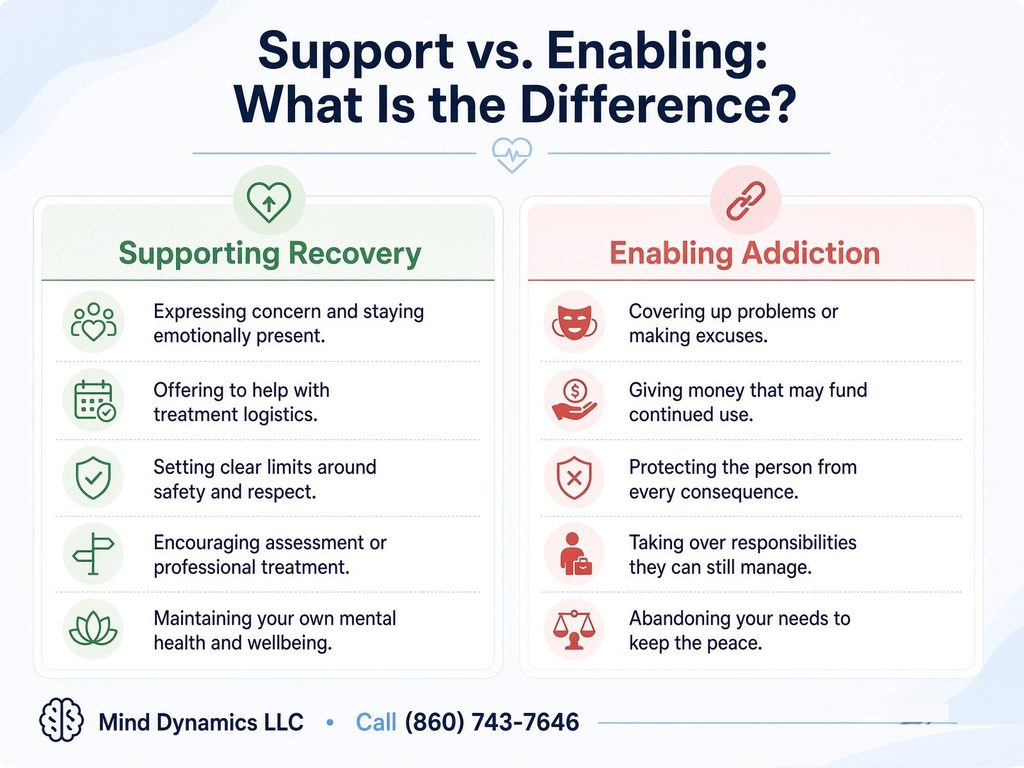
Support vs Enabling: What Is the Difference?
This distinction is one of the most important and most misunderstood parts of helping someone with addiction.
| Support | Enabling |
| Expressing concern and staying emotionally present | Covering up problems or making excuses |
| Offering to help with treatment logistics | Giving money that may fund continued use |
| Setting clear limits around safety and respect | Protecting the person from every consequence |
| Encouraging assessment or treatment | Taking over responsibilities they can still manage |
| Maintaining your own wellbeing | Abandoning your needs to keep the peace |
Support keeps the relationship open while refusing to participate in patterns that sustain the addiction. Enabling reduces short-term conflict but often protects the substance use from its natural impact.
The line is not always obvious in the moment. Many families enable because they are afraid of what will happen if they stop. Fear is understandable. The challenge is learning how to care without continuing patterns that keep the problem stable.
A useful question is: Am I helping this person move toward health, or am I making continued use easier to maintain? The answer is not always comfortable, but it is clarifying.
How to Set Boundaries Without Abandoning Someone
Boundaries are not punishments. They are limits that protect your wellbeing and clarify what you will and will not participate in.
Effective boundaries are usually specific, enforceable, communicated calmly, and consistent over time.
Examples include:
– I will not give money that may be used for substances
– I will not lie to employers, family members, or others to cover for you
– You may not use in this home
– I am willing to help with treatment, but I will not continue rescuing you from every consequence of use
Boundaries work best when they are paired with a clear offer of support. The message becomes: I will not help sustain the addiction, and I will help if you are ready to take a step toward change.
This combination is more effective than either pure distance or pure rescue. Pure distance can feel like abandonment. Pure rescue can keep the addiction insulated from reality. A boundaried form of care holds both concern and limits at the same time.
It is also important to choose boundaries you can actually maintain. A boundary that collapses every time conflict rises teaches the opposite of what you intend.
When a Professional Intervention May Be Appropriate
A formal intervention is not the right tool in every situation. In some cases it can help create a structured moment of clarity. In others it can increase defensiveness if the person feels ambushed or shamed.
An intervention may be worth considering when the situation has become increasingly dangerous, previous informal conversations have gone nowhere, the family needs a coordinated approach, and a specific treatment option is already arranged and available.
An intervention is less useful when the family is highly divided, when the process is driven mainly by anger, or when no realistic treatment plan is ready if the person says yes.
Professional guidance can help families decide whether an intervention is appropriate and how to approach it in a way that reduces harm. The quality of preparation often matters more than the intensity of the meeting itself.
What If They Finally Agree to Treatment?
When a person becomes willing to take a step, speed and clarity matter. Motivation can be fragile. Families should be prepared with practical next steps rather than scrambling after a rare moment of openness.
Helpful preparation includes knowing which programs can complete an assessment quickly, understanding the difference between detox, outpatient care, IOP, and PHP, having insurance information ready, and reducing logistical barriers such as transportation or time off work.
Not every person who agrees needs residential treatment. Some are appropriate for outpatient detox, Intensive Outpatient Programming, or Partial Hospitalization depending on clinical need and safety. Matching the level of care to the actual need is more useful than pushing the most intensive option available.
You can learn more about structured outpatient options on our Addiction Treatment in Connecticut page.
Families can also explore our Intensive Outpatient Program in Connecticut to understand what that level of care involves.
Our Partial Hospitalization Program in Connecticut is another option when more structure is needed.
How Family Support Fits Into Recovery
Even when a loved one eventually enters treatment, the family role does not disappear. Recovery often requires changes in communication, expectations, boundaries, and trust on both sides.
Family involvement can help reduce conflict, improve follow-through, and create a more stable environment after formal treatment ends. It can also help family members recover from the stress, fear, and exhaustion that often build during active addiction.
Support for families is available through our family program in Connecticut.
The goal is not to control the other person. The goal is to create conditions that make recovery more sustainable for everyone involved. Families who receive support of their own are often better able to maintain healthy boundaries and avoid slipping back into old patterns.
Addiction Treatment Resources in Central Connecticut
Families in Connecticut often feel stuck because they do not know what realistic local options look like. Having clear information reduces panic and helps you respond when a window of willingness opens.
Mind Dynamics is based in Plainville and works with individuals and families from Hartford, Bristol, Farmington, New Britain, West Hartford, Southington, and surrounding Central Connecticut communities.
Depending on clinical need, support may include outpatient detox, Intensive Outpatient Programming, Partial Hospitalization, ongoing outpatient care, and family involvement. The right starting point depends on safety, severity, mental health needs, and the person’s current willingness.
If you are trying to understand what options exist for your family, a conversation with a clinical team can help clarify next steps even if your loved one is not yet ready. Sometimes the first useful step is simply getting clear on what is available and what would be appropriate if willingness increases.
You can call us at (860) 743-7646.
Frequently Asked Questions
Can I force my adult child or spouse into rehab?
In most cases, no. Adults generally cannot be forced into treatment solely because family members want it. Limited legal exceptions exist in specific circumstances, but they are not available in every situation.
What should I do if they refuse every offer of help?
Focus on what you can control: your boundaries, your enabling patterns, your own support, and your readiness to respond quickly if they become more open.
Is it wrong to stop giving money or housing support?
Not necessarily. Removing financial or practical support that sustains active use can be part of setting healthy boundaries. These decisions should be made carefully and, when possible, with professional guidance.
Should I stage an intervention?
Sometimes. Interventions can help in certain situations, especially when a clear treatment plan is ready. They are less effective when driven mainly by anger or when the family is highly divided.
What if they agree to talk but not to enter treatment?
An assessment or educational conversation can still be a useful step. Not every person begins with full program admission. Smaller steps sometimes reduce resistance.
How do I help without enabling?
Support the person and their recovery efforts. Do not protect them from every consequence of continued use. Offer help with treatment logistics while refusing to fund or cover the addiction.
Can outpatient treatment work if they are still ambivalent?
Some people enter outpatient care with mixed motivation. Clinical support, structure, and family involvement can help strengthen engagement over time, depending on the situation.
Where can families in Connecticut get support?
Families can seek guidance through local treatment providers, family programs, and clinical assessments. Mind Dynamics works with families across Central Connecticut and can help clarify realistic options.
What if I am afraid they will cut me off if I set boundaries?
That fear is common. Boundaries do carry relational risk. At the same time, continuing without limits often carries a different cost: ongoing chaos, resentment, and emotional exhaustion. Professional support can help families weigh these decisions more carefully.
Taking the Next Step
Helping a loved one who refuses treatment is one of the hardest positions a family can be in. You cannot create another person’s readiness by force. You can respond in ways that protect your wellbeing, reduce enabling, and keep a clear path to help available.
If you are trying to figure out what to do next, you do not have to sort through it alone. A conversation with a clinical team can help you understand options, boundaries, and realistic next steps for your situation.
Call Mind Dynamics at (860) 743-7646.