If you stopped drinking last night, or you cut back hard, and this morning your hands are shaking, you are sweating, and you cannot sleep, that can be alcohol withdrawal. It is not a character problem. It is the body reacting after it adapted to alcohol. For some people in Plainville, Hartford, Bristol, and the rest of Hartford County, the next step is a same-day assessment for outpatient detox. For others, the next step is the emergency room. The difference is safety, not toughness.
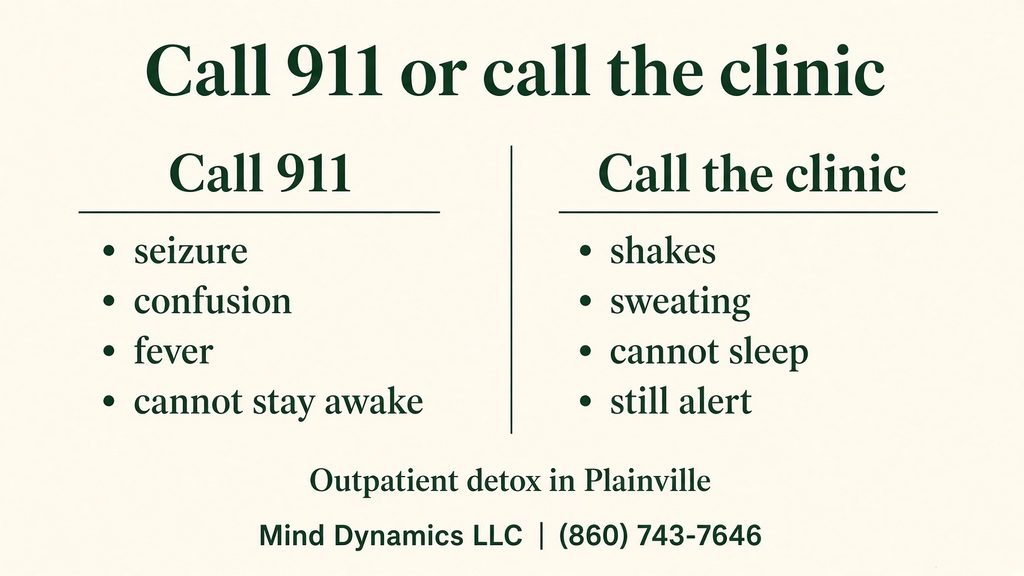
If this is already happening, call Mind Dynamics at (860) 743-7646. Do not wait for a worse morning to decide. If there is a seizure, confusion, a fever, chest pain, or someone cannot stay awake, call 911. Do not drive them to the clinic.
Quick answer
Alcohol withdrawal is the set of symptoms that can start within hours after a person who has been drinking heavily stops or sharply cuts back. Early signs are shakes, sweating, nausea, anxiety, a fast heartbeat, and trouble sleeping. The dangerous window is often the first one to three days. A seizure, confusion, fever, or vomiting that will not stop is an emergency. Mild to moderate symptoms, a stable home, and someone there can be assessed for outpatient detox in Plainville. Outpatient detox is not a promise that everyone is safe to go home. A clinician decides that.
What alcohol withdrawal actually is
Alcohol slows the brain down. When someone drinks heavily for long enough, the brain pushes back so the person can still function. That push does not turn off the hour the drinking stops. For a while the brain is still in high gear, and the body feels it. That is withdrawal.
People in Connecticut often describe it in ordinary language. The shakes. The sweat. The 3 a.m. wake-up. The drink in the morning that makes the hands steady enough to drive to work in Hartford or Bristol. They do not call it a syndrome. They call it the only way the day starts.
That morning drink is a clue. If a person needs alcohol to stop the shaking, the body is already dependent. Stopping on willpower alone is not a plan. It is a risk. Some people get through a rough day. Some people have a seizure in the kitchen. You cannot tell which one you will be by how strong you feel at noon.
This is also why families get confused. From the outside it can look like a hangover, or anxiety, or a bad night. From the inside it can be the start of a medical problem. The outpatient detox page explains the clinical name, ambulatory withdrawal management, and who it is for. This article is about the symptoms and the safety line.
The timeline most people are not told
Withdrawal is not one moment. It moves. Knowing the window helps a family in Farmington or New Britain decide whether to watch, call the clinic, or call 911.
The first 6 to 12 hours
This is the part people recognize. Hands shake. The shirt is damp. The stomach turns. Sleep will not come, or it comes in short pieces. Anxiety sits in the chest. The heart feels fast. Some people get a headache. Some get irritable with everyone in the house. A person may still look like they could go to work.
This is also the hour people talk themselves out of help. They have felt this before. They have a bottle in the cabinet. They tell the family they will taper. A taper without a clinician is not a medical plan. It is another day of drinking.
12 to 48 hours
This is the window where things can turn. Some people see or hear things that are not there. Some have a seizure. A seizure can happen even if the person seemed only mildly shaky a few hours earlier. It does not always come with a long warning.
If someone has had a withdrawal seizure before, this window is not a watch-and-wait. It is a reason to be in a medical setting, not alone in a bedroom in West Hartford or Southington.
Day 2 to day 3
For some people the worst is here, not on the first morning. Confusion. A fever. A racing heart. Sweating that soaks the sheets. Not knowing where they are. This can be alcohol withdrawal delirium, the condition people used to call delirium tremens. It is an emergency. It is not something to ride out at home because the person does not want to go to a hospital.
The timeline is a guide, not a guarantee. Some people peak earlier. Some people with other illnesses get into trouble faster. Age, other medications, and a history of seizures all change the risk. That is why an assessment matters more than a chart on the internet.
When it is an emergency
Call 911 if any of these are happening. Do not drive the person to Plainville to see if the clinic can handle it.
A seizure. Confusion about where they are or who you are. A fever. Vomiting that will not stop. Chest pain. Trouble breathing. A person who cannot stay awake, or who cannot be woken. Hallucinations with a fast heart and heavy sweating. A fall with a head injury. Any of these can mean the withdrawal is no longer an outpatient problem.
Severe alcohol withdrawal can be life-threatening. That is not a slogan. It is the reason hospitals exist for this. Mind Dynamics is an outpatient clinic. We assess people for day treatment and home at night. We do not replace an emergency department when the symptoms are already severe.
If you are the family member and you are unsure, treat it as an emergency. A false alarm is cheaper than a seizure in the car on Route 72.
When outpatient detox can be assessed
Outpatient detox, clinically called ambulatory withdrawal management, is medical support for withdrawal without an overnight stay. The person comes to the clinic in Plainville during the day and goes home at night. It is for people who need monitoring and still have a job, a family, or a bed they need to sleep in.
It can be considered when the symptoms look mild to moderate, the person has a stable place to sleep, someone can be there, and there is no history of withdrawal seizures or severe withdrawal delirium. A clinician still has to say yes. A website cannot clear someone for outpatient care.
People who often fit this picture are the ones still going to work in Hartford or Bristol, still picking up a child, still trying to keep the household running. They are not in a movie version of rock bottom. They are in a kitchen at 6 a.m. with shaking hands, and they want a plan that does not require them to disappear for a week.
The full description of that option is on the outpatient detox in Plainville page. If you want the day-to-day picture of monitoring, the realities article covers how a clinic day is structured. This page is the safety decision.
A simple way to sort the next step
| What you are seeing | What to do |
| Seizure, confusion, fever, chest pain, cannot stay awake | Call 911. Do not drive to the clinic. |
| Shakes, sweat, no sleep, nausea, anxiety, still alert and oriented | Call (860) 743-7646 for a same-day assessment. |
| History of withdrawal seizures or severe withdrawal delirium | Do not plan on outpatient. Get a medical setting first. |
| No stable home, or no one there at night | Outpatient may not be safe. Say that on the call. |
| Morning drinking to stop the shakes, but still functioning | This is dependence. Assessment is appropriate. Do not wait for a worse week. |
Signs families in Hartford County already know
These are the signs we hear on the phone. They are not a diagnosis. They are a reason to call.
The person drinks in the morning to stop the shaking. They hide how much they drank the night before. They cannot sleep unless they have had enough. They sweat through a shirt while sitting still. Their heart races when they try to skip a day. They get irritable or scared in the late afternoon. They have tried to stop for a weekend and went back because the symptoms were too much. Someone at home is worried and has started counting bottles. They have had a seizure when they stopped before. They are also taking benzodiazepines, which raises the risk.
One sign is enough to call. You do not need all of them. You do not need a rock bottom story.
What the Plainville visit is, and what it is not
A visit for outpatient detox starts with an assessment. The clinician looks at how much the person has been drinking, for how long, what happened the last time they stopped, other medical problems, other medications, and whether home is stable. Vital signs get checked. The person is asked, plainly, about seizures, confusion, and hallucinations.
If outpatient is appropriate, there is a plan for the next days. The person comes in. They are monitored. They go home. If outpatient is not appropriate, we say so. Safety comes before convenience. Sending someone home who needs a hospital is not kindness.
What the visit is not: a guarantee. A lecture. A requirement that the person has already hit a public crisis. A program that asks them to white-knuckle the night with no medical eyes on them.
Veterans and TRICARE families can ask about coverage on that same call. Mind Dynamics is a VA Community Care Network provider, and TRICARE may cover eligible outpatient care when it is authorized. Coverage is not automatic. Ask.
Why people wait, and what the wait costs
People wait because they have a job. They wait because they do not want a neighbor in Plainville to know. They wait because a past program felt like a warehouse. They wait because a family member said they should just stop. They wait because the symptoms eased after one drink and they told themselves it was only anxiety.
The cost of the wait is not abstract. The first 48 hours are when seizures show up. A person who drives to work in Hartford while shaking is a risk to themselves and to other people on the road. A person who keeps a morning drink going for another month is deeper into dependence, not closer to a clean stop.
Waiting for a Monday, or for after a family event in Farmington, or for the holidays to pass, is how a manageable assessment becomes an emergency room visit. If the symptoms are here now, the call is now.
What happens after the shakes stop
Detox is the medical start. It is not the finish. The body can be steadier in a few days and the person can still be one hard evening away from a drink. That is normal. It is also why stopping at detox is how people end up doing detox again.
After the acute symptoms settle, many people need structure. A partial hospitalization program is day treatment with home at night. An
The other half is what the drinking was doing. Shame, anxiety, a marriage that only works when everyone is careful, a job that rewards the person for never stopping. That is the work after the body is stable. We have written about why sobriety alone is not enough because we see people get physically clear and stay emotionally stuck.
Family is in this whether anyone planned it or not. A spouse in New Britain who has been managing the mornings needs a role that is support, not surveillance. The family program and the
Questions worth asking on the call
You can use these. You do not need the perfect words.
Can you assess me today, or tomorrow morning? What would make outpatient unsafe for me? What should the person at home watch for tonight? If you say I need a hospital, where do I go? After the withdrawal is managed, what is the next level of care, and can I keep working? Do you work with VA Community Care or TRICARE? What does a day in Plainville actually look like?
A clinic that will not answer the safety question is not the right clinic. We will answer it.
Local note for Hartford County
Mind Dynamics is in Plainville, at 17 Farmington Ave. People come from Plainville, Hartford, Bristol, New Britain, Farmington, Southington, West Hartford, Newington, Berlin, and Avon. The drive is the point. You come in during the day. You sleep in your own bed. You are not sent across the state for a bed that may not exist tonight.
If you are still deciding between levels of care after the withdrawal question is settled, the addiction treatment in Connecticut page lays out PHP, IOP, and outpatient detox in one place. Start with the withdrawal question. The program question comes after someone is safe.
What this article will not do
It will not give medication doses. Doses are a clinical decision for a specific person, not a blog. It will not say outpatient detox is safe for severe withdrawal. It is not. It will not tell a teenager this is for them. It will not tell you to taper alone over a weekend. It will not treat a seizure as something to sleep off.
If a page online gives you a home schedule of pills for alcohol withdrawal, close it. That is not care.
Questions people ask
How long after my last drink do symptoms start?
Often within 6 to 12 hours. Some people feel it sooner. The dangerous complications, including seizures, are most often in the first one to three days. Do not use a quiet first evening as proof that you are fine.
Can I just taper at home in Plainville?
A self-made taper is how people stay in the cycle. If you are shaking without a drink, you need an assessment, not a private schedule. Call (860) 743-7646.
Is outpatient detox the same as quitting at home?
No. Outpatient detox is medical monitoring at a clinic, with a plan, and home at night. Quitting at home alone is neither of those things.
What if I had a seizure the last time I stopped?
Tell us on the call. A past withdrawal seizure is a reason outpatient may not be safe. Do not hide it to get a lighter option.
Can I keep working?
Many people who are appropriate for outpatient detox are people with jobs. Whether you should work on a given day is part of the assessment. Do not decide that from a blog.
What if I am a veteran or on TRICARE?
Ask. Eligible veterans may be able to use VA Community Care. TRICARE may cover eligible outpatient services when authorized. Bring it up on the first call so we do not build a plan you cannot use.
When should a family member call 911 instead of the clinic?
Seizure, confusion, fever, chest pain, vomiting that will not stop, or a person who cannot stay awake. If you are unsure, call 911.
If this is the morning you already know
You do not need a worse week. You need a plan for the symptoms that are already here. If you are in Plainville, Hartford, Bristol, New Britain, Farmington, or the towns around them, and the shakes, the sweat, or the sleepless night have started, call Mind Dynamics at (860) 743-7646. If the symptoms are severe, call 911 first. Safety is the whole point.
The clinic page is outpatient detox in Plainville. The phone is (860) 743-7646.