
If you are looking into addiction treatment in Connecticut, you have probably come across the term outpatient detox. Some people call it ambulatory withdrawal management. It sounds simple on the surface: you go in for medical support during the day and go home to sleep in your own bed at night.
But in reality, there is a lot more to it than most people realize, especially if this is your first time exploring recovery options. The gap between what people expect from a detox program and the day to day clinical reality can be vast. When individuals or families begin researching how to safely stop using alcohol, benzodiazepines, or opioids, they are often met with a wall of clinical jargon that raises more questions than it answers.
Many individuals in Hartford, Bristol, Farmington, and Plainville assume that detox always requires checking into a hospital setting or a residential facility around the clock. Because that 24 hour image is so common in media, movies, and traditional healthcare culture, people are often surprised to learn there is another legal and medically sound way forward.
But outpatient detox is not just a lighter or watered down version of inpatient care. It is a completely different clinical modality. It comes with its own unique set of structures, therapeutic protocols, and daily realities that do not always get talked about openly in marketing brochures.
At Mind Dynamics in Plainville, we walk people through these choices every single day. Some are scared that an outpatient model will not offer enough physical or medical support during the acute phases of withdrawal. Others worry about whether they can handle the heavy emotional side of early sobriety while still living at home, surrounded by their everyday stressors and family dynamics. These concerns are completely valid, they deserve honest, transparent answers rather than a standard sales pitch.
To determine if this level of care is right for you, it helps to pull back the curtain on exactly how these programs operate from the moment you walk through the door.
What Outpatient Detox Actually Looks Like Day to Day
The process does not start with a treatment schedule, it starts with a rigorous gatekeeping process centered entirely on patient safety. Understanding the day to day structure of ambulatory detox helps take the anxiety out of the first few steps, allowing you to prepare mentally and logistically for the commitment. You can learn more details about this process by visiting the Mind Dynamics page on ambulatory withdrawal management.
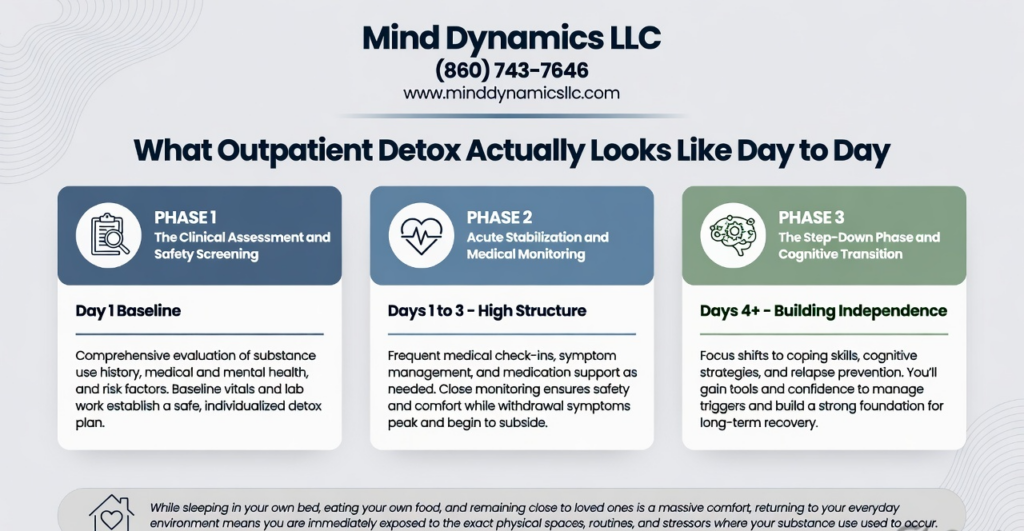
The standard clinical timeline generally flows through three distinct, highly monitored phases:
Phase 1: The Clinical Assessment and Safety Screening (Day 1 Baseline)
Before a single dose of comfort medication is prescribed or a therapeutic session begins, our medical team conducts an exhaustive evaluation. This is not a simple intake form. It is a comprehensive medical and psychological deep dive into your substance use history, the specific quantities and duration of substances consumed, past withdrawal complications such as seizures or delirium tremens, physical health biomarkers, and co-occurring psychiatric conditions.
Crucially, we also evaluate your external environment. We assess whether your home life is stable, whether you have a sober support person available, and whether you have reliable means to travel to the clinic daily. Because safety is the absolute priority, if someone is facing severe, life threatening medical risks or an unstable, chaotic living situation, we will immediately redirect them and help them transition directly to a 24 hour inpatient facility.
Phase 2: Acute Stabilization and Medical Monitoring (Days 1 to 3 – High Structure)
Once approved for ambulatory care, your initial few days require a significant time commitment and are highly structured. You will visit our Plainville clinic daily, and during the critical first 48 hours, you may be required to come in multiple times a day.
During these medical check ins, nursing and medical staff monitor your vital signs, including blood pressure, heart rate, and temperature. They utilize standardized clinical tracking tools like the Clinical Institute Withdrawal Assessment for Alcohol (CIWA) or the Clinical Opiate Withdrawal Scale (COWS) to objectively measure the severity of your symptoms.
Based on these numbers, physicians adjust your taper schedule or comfort medications in real time to ensure you remain safe, stable, and as physically comfortable as possible. This phase is entirely focused on mitigating the dangerous physical spikes of acute withdrawal.
Phase 3: The Step-Down Phase and Cognitive Transition (Days 4+ – Building Independence)
As your physical biomarkers settle and your body begins to stabilize, the physical urgency decreases, and your required medical visits become less frequent. However, the care framework does not disappear, it simply shifts its focus.
The clinical priority moves away from purely physical medical management and transitions toward psychological grounding. You begin introducing basic cognitive behavioral coping skills, learning how to identify immediate triggers, and working closely with a counselor to map out a long term recovery strategy. The medical team remains on standby, but your time spent in the clinical space begins to blend with your return to normal daily routines.
The Nighttime Reality: One thing that surprises many people is how much of the actual work of outpatient detox happens entirely outside our clinical walls. Managing your evenings, nights, and weekends on your own can feel incredibly liberating, but it can simultaneously feel deeply overwhelming. While sleeping in your own bed, eating your own food, and remaining close to loved ones is a massive comfort, returning to your everyday environment means you are immediately exposed to the exact physical spaces, routines, and stressors where your substance use used to occur.
If your typical routine involved drinking or using immediately after work or during quiet evenings, those hours will suddenly feel very loud and very long. This is why having an explicit, hour by hour evening plan and a designated sober contact at home is not just recommended, it is a mandatory part of the outpatient treatment design.
The Hidden Hurdle: The Emotional Thaw
Most people enter the detox process expecting an entirely physical challenge. They prepare themselves to deal with sweating, nausea, muscle aches, insomnia, fatigue, and intense headaches. They view detox as a medical hurdle to clear, assuming that once the substance is physically out of their system, the hardest part is behind them.
What catches the vast majority of individuals completely off guard is how quickly and aggressively deep seated emotions begin to surface the moment substances stop numbing the brain’s chemical receptors.
At Mind Dynamics, we call this phenomenon the emotional thaw. When you choose an inpatient facility, you are effectively insulated from the real world in a controlled environment with round the clock distractions, group schedules, and staff.
When you choose an outpatient environment in Connecticut, you do not have that total insulation. Quiet evenings at home, a rainy weekend afternoon, or even the solitary drive back from the Plainville clinic can suddenly trigger a massive flood of dormant anxiety, sudden grief, intense anger, or intrusive memories that you may have been actively avoiding or self-medicating for years.
This sudden emotional surge is not a sign that your detox is failing, nor is it a sign that you are getting worse. It is a direct indication that your central nervous system is waking back up from a chemically induced sleep. It is a normal, necessary part of true long term healing, but it can feel incredibly raw and terrifying if you are not forewarned and prepared for it. You can find out more about how we integrate targeted emotional care and psychiatric support during this highly vulnerable phase by reviewing our drug and alcohol detox page.
Furthermore, ambulatory detox requires an exceptionally high degree of personal accountability and self-honesty that inpatient care simply does not demand of you. In a residential facility, your meals, medications, and schedule are entirely managed by staff, your compliance is heavily monitored. In an outpatient program, there is no medical staff watching your behavior 24 hours a day. The medical protocol only works if you are entirely willing to partner with your care team. This means you must:
- Show up consistently and on time to every single scheduled medical check in.
- Take all prescribed tapers or comfort medications exactly as directed, without skipping doses or altering amounts.
- Maintain absolute, transparent honesty with your counselors and nurses about cravings, slip ups, or how you are genuinely feeling mentally and physically.
For many individuals, this level of personal responsibility feels deeply empowering. It serves as tangible proof to themselves that they can actively participate in their own recovery while living in the real world. For others, particularly those dealing with severe fatigue or cognitive fog during early withdrawal, it can feel like an immense amount of pressure during an already exhausting week. Recognizing which side of that line you fall on is essential before making a commitment.
Outpatient vs. Inpatient: Finding Your Safest Fit
Outpatient detox is an incredibly effective, evidence based medical modality, but it is fundamentally not a universal solution for every single individual. Choosing the safest path requires looking with complete honesty at your personal medical history, the specific substances involved, and the daily structural realities of your home environment.
To help you objectively weigh these two very different approaches side by side, review the clinical criteria below:
| Ideal Candidate for Outpatient Detox | Better Suited for Inpatient Care |
| Anticipated physical withdrawal symptoms fall into the mild to moderate range based on usage history. | Clear history of severe, complicated withdrawal including past seizures, hallucinations, or delirium tremens (DTs). |
| A stable, safe, and entirely substance-free home environment with an active, supportive sober ally present. | Living in a chaotic, highly stressful, or unsupportive environment where others are actively using substances. |
| Possesses reliable, daily transportation to attend mandatory morning and afternoon medical checks in Plainville. | Lacks reliable transit, lives too far from the clinical facility, or requires continuous, round the clock nursing oversight. |
| Has critical, non-negotiable family duties, caregiving roles, or career obligations that cannot be put on pause. | Able and willing to step completely away from daily life, work, and family to focus entirely on an isolated reset. |
| No severe, unmanaged, or acute co-occurring medical conditions (like advanced liver disease or severe heart issues). | Struggles with complex, acute physical illnesses or unstable psychiatric conditions requiring constant clinical monitoring. |
Our core clinical philosophy, which you can explore further on our main addiction treatment page, is built on clinical integrity. We never recommend or push an outpatient detox program simply because it is the specific service we offer.
We only clear an individual for ambulatory withdrawal management when the objective intake data, medical history, and environmental assessments prove beyond doubt that the process can be completed safely, comfortably, and effectively without round the clock hospitalization. If the risks are too high, we will always advocate for an inpatient start to ensure your physical safety.
What Happens After Detox Ends?
One of the most common and dangerous misconceptions surrounding addiction recovery is the belief that successfully completing a detox program means you are cured or finished with treatment. This misunderstanding leads to high rates of avoidable relapse.
Detox is an essential, life saving medical intervention, but its scope is strictly limited: it is designed to clear toxins from your physical body safely and comfortably. It does absolutely nothing to address the deep rooted behavioral patterns, psychological coping mechanisms, trauma, or emotional triggers that drove the substance use in the first place.
When you step out of detox, your body may be clean, but your mind is still incredibly vulnerable. The brain pathways that associate stress with substance use are still highly active. Without an immediate, seamless transition into a structured therapeutic environment, the risk of a relapse spikes dramatically within the first few weeks of completing detox. Real, sustainable, long term recovery only occurs when you transition directly from medical stabilization into ongoing behavioral healthcare.
To prevent individuals from slipping through the cracks during this highly critical window, the team at Mind Dynamics works collaboratively with each patient to build a concrete, individualized step down plan well before their final day of detox. Depending on your personal progress, employment status, and the level of structural accountability you still require, we ensure a direct handoff into one of our ongoing programs:
- High Structure Continuing Care: For those who require comprehensive, full day therapeutic immersion while still returning home at night, transitioning directly into our structured partial hospitalization program provides the ideal therapeutic bridge.
- Moderate Structure Continuing Care: For individuals who are ready to begin carefully balancing their early recovery work with a return to part time employment or family schedules, stepping down into our flexible intensive outpatient program offers group therapy and individual counseling multiple days a week without disrupting your daily routine.
Taking the Next Step in Your Recovery
Making the conscious decision to halt substance use and seek professional detox is a monumental milestone in a person’s life. It is entirely normal, and expected, to feel a complex mix of intense hope for the future and quiet, paralyzing fear about the actual process.
Ambulatory withdrawal management is an exceptional, modern medical tool for residents throughout Hartford, Bristol, Farmington, West Hartford, and Plainville who require clinical care but simply cannot afford to put their families, parenting duties, or careers on hold for a month.
However, it is vital to remember that outpatient detox works best when it is viewed not as a standalone solution, but as the foundational first chapter of a much broader, comprehensive recovery story.
If you are currently reading this and trying to determine whether outpatient detox is the safest, most logical choice for yourself or someone you love, you do not have to figure it out alone. The most effective step you can take right now is to step away from internet research and have an open, completely transparent, no pressure conversation with a trained clinical professional who understands the system.
You can visit our main addiction treatment website at Mind Dynamics to reach out to our team privately and securely. There are no obligations, no forced choices, and no generic answers. We are here to listen, evaluate your unique situation honestly, and help you chart the safest path forward whenever you are ready to make the call.