
A honest look at the hidden patterns that keep people trapped in cycles of relapse, and what real recovery actually requires in central Connecticut.
You did it. You got sober. You went through detox, finished a program, maybe even stayed clean for weeks or months. And then… something happened. The cravings came back. The old feelings returned. Before you knew it, you were right back where you started.
Or maybe you are still sober, but you do not feel any better. You are not using, but you still feel empty, anxious, depressed, or disconnected. Life feels flat. Nothing brings you real joy. You keep wondering, “Is this all there is to being sober?”
If this sounds familiar, you are not alone. And more importantly, it is not your fault.
What many people in Plainville, Hartford, Bristol, Farmington, and across central Connecticut are discovering is that getting sober is only the first step. The real challenge is something most treatment programs do not talk about enough: emotional addiction.
This article will help you understand what emotional addiction really is, why it keeps people stuck even after they stop using, and what you can actually do about it.
What Is Emotional Addiction?
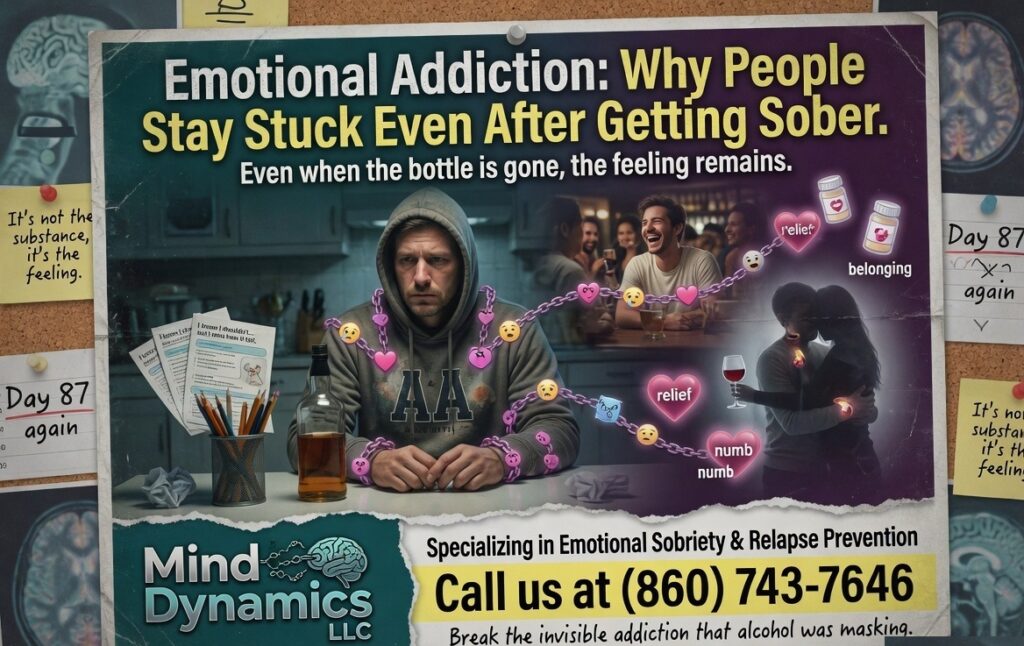
Emotional addiction is the tendency to recreate painful emotional states even when you are no longer using substances. It is the invisible force that keeps people trapped in the same cycles of thinking, feeling, and behaving, long after the drugs or alcohol are gone.
Here is the hard truth: many people are sober but still emotionally addicted to the same patterns that led them to use in the first place. They are not addicted to the substance anymore, but they are addicted to the emotional experience that came with it.
Think about it. When someone uses, they are often chasing a feeling. Maybe it is escape from anxiety. Maybe it is relief from shame or loneliness. Maybe it is a sense of power or connection that feels missing in their normal life. The substance becomes a shortcut to that feeling.
When you take the substance away, the feeling does not automatically disappear. The brain has learned to associate certain emotional states with relief. So even without the drugs or alcohol, the person keeps returning to the same emotional patterns. They might not be using, but they are still living in the same emotional prison.
This is why so many people in central Connecticut get clean, feel hopeful for a while, and then slowly slide back into old behaviors. The substance is gone, but the emotional addiction remains.
Why Emotional Addiction Is So Hard to Break
Emotional addiction is powerful because it operates below the surface. Most people do not even realize it is there. They think, “I am sober now, so why do I still feel so bad?” or “Why do I keep making the same mistakes?”
Here are some of the reasons emotional addiction is so difficult to overcome:
1. It Feels Normal
When you have lived with certain emotional patterns for years, they start to feel like “just who you are.” Feeling anxious all the time, being hard on yourself, pushing people away, or staying stuck in shame can become your normal. You do not even question it anymore.
2. It Is Tied to Identity
For many people, their addiction became part of how they saw themselves. “I am the person who always messes up.” “I am the one who cannot handle life without something to take the edge off.” When you stop using, you are not just giving up a substance. You are giving up a part of your identity. That can feel terrifying.
3. Family and Relationship Patterns Reinforce It
Emotional addiction does not happen in a vacuum. It often develops within family systems. If you grew up in a home where emotions were ignored, punished, or expressed in unhealthy ways, you learned to survive by shutting down, people-pleasing, or numbing out. Those patterns do not disappear just because you get sober. In fact, they often get stronger when you try to change.
4. The Brain Has Been Trained
Addiction changes the brain. It strengthens certain neural pathways and weakens others. Even after you stop using, your brain may still default to old ways of thinking and feeling. It takes time, repetition, and the right support to rewire those patterns.
Signs You Might Be Struggling with Emotional Addiction
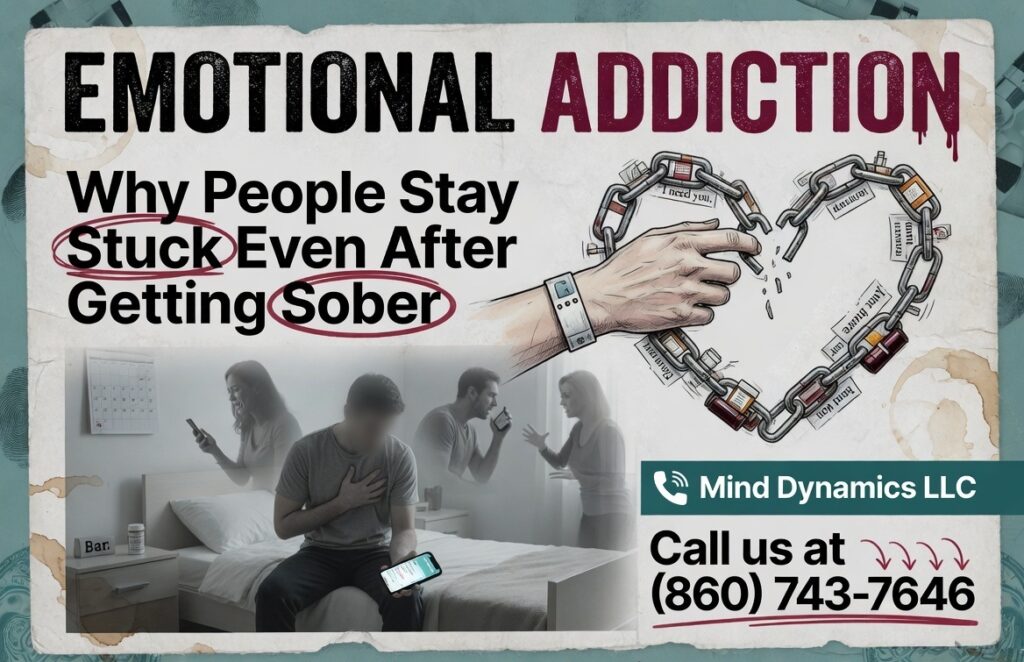
Many people in Plainville, Hartford, Bristol, and surrounding towns come to us thinking they just need to “stay sober longer.” But when we dig deeper, we often find emotional addiction at the root. Here are some common signs:
- You are sober but still feel empty, depressed, or anxious most of the time
- You keep having the same arguments or conflicts with family members
- You feel like you are “white knuckling” through life
- Small setbacks feel like the end of the world
- You have a hard time asking for help or being vulnerable
- You find yourself returning to old coping mechanisms (even if they are not substances)
- You feel like you are just going through the motions
- Deep down, you wonder if real happiness is even possible for you
If several of these resonate with you, emotional addiction may be playing a bigger role in your recovery than you realized.
Why Traditional Treatment Often Misses This
Most addiction treatment programs focus on stopping the behavior. They teach you about triggers, coping skills, and relapse prevention. These things are important, but they often do not go deep enough.
Many programs treat addiction like a bad habit that needs to be broken. They do not address the emotional patterns underneath. As a result, people leave treatment sober but still emotionally addicted. They have new tools, but they are still carrying the same emotional baggage.
This is especially true for people in central Connecticut who have tried multiple programs. They keep getting clean, but they do not feel fundamentally different. The cycle repeats because the emotional addiction was never fully addressed.
At Mind Dynamics in Plainville, we see this pattern all the time. That is why we take a different approach.
How We Approach Emotional Addiction at Mind Dynamics
We believe that lasting recovery requires more than just stopping substances. It requires healing the emotional patterns that keep people stuck. This is the heart of our LEAP process (Life Extraordinary Approach Process).
We Help People Understand Their Emotional Patterns
In our PHP and IOP programs, we go beyond surface-level coping skills. We help clients understand why they feel the way they do. Where did these emotional patterns come from? What purpose did they serve in the past? What are they costing you now?
We Focus on Family Healing
Emotional addiction rarely develops in isolation. It is often shaped by family dynamics. That is why we involve families in the recovery process. Parents, spouses, and loved ones learn how to communicate differently, set healthy boundaries, and create a home environment that supports emotional growth instead of reinforcing old patterns.
We Practice Real-Life Application
Unlike residential programs that remove people from their environment, our outpatient programs in Plainville allow clients to practice new emotional skills while still living their real lives. They learn how to handle stress at work, communicate with family members, and manage difficult emotions without returning to old coping mechanisms.
We Emphasize Emotional Integrity and Accountability
True recovery requires radical honesty with yourself and others. We help clients develop the courage to face uncomfortable emotions instead of avoiding them. This is not easy work, but it is the work that leads to real freedom.
Real Stories from Central Connecticut
We have worked with many people in Hartford County and surrounding areas who were sober but still struggling. Here are a few examples (names changed for privacy):
Mark from Bristol had been sober for over a year when he came to us. He was not using, but he felt completely numb. He described his life as “gray.” Through our PHP program, he discovered that he had been emotionally addicted to feeling “nothing” for most of his life. As he learned to feel his emotions instead of shutting them down, his whole world started to come back into color. Today, he says he finally understands what it means to be truly sober.
Sarah from Farmington had completed multiple residential programs. She always relapsed within a few months of coming home. What she discovered through our IOP program was that her emotional addiction to shame and self-criticism was driving her back to old behaviors. As she and her family worked together to change these patterns, her recovery finally started to stick. She has now been sober for over two years.
David from Plainville was sober but still felt like he was “one bad day away from a relapse.” He lived in constant fear. Through our program, he learned that his emotional addiction to anxiety and hypervigilance was keeping him trapped. As he practiced new ways of relating to his emotions and his family, the fear started to lose its power. He now describes himself as “sober and actually free.”
What You Can Do Right Now
If you recognize yourself in any of this, here are some steps you can take today:
1. Get Honest About How You Really Feel
Stop telling yourself you “should” feel better just because you are sober. How do you actually feel? What emotions have you been avoiding or numbing? Write them down. Say them out loud. Awareness is the first step.
2. Look at Your Relationships
Emotional patterns are often reinforced by the people closest to us. Are there relationships in your life that keep you stuck in old ways of thinking and feeling? What would it look like to set healthier boundaries?
3. Consider Getting the Right Kind of Support
Not all treatment programs address emotional addiction. Look for programs that go beyond traditional relapse prevention and focus on emotional healing, family dynamics, and real-life application. Our PHP and IOP programs in Plainville are designed specifically for this deeper work.
4. Be Patient with Yourself
Changing emotional patterns takes time. You did not develop these patterns overnight, and you will not unlearn them overnight either. Give yourself grace as you do this work.
Frequently Asked Questions
Can you be sober and still emotionally addicted? Yes. This is actually very common. Many people in central Connecticut are sober but still struggle with the same emotional patterns that led them to use in the first place. True recovery requires addressing both the substance use and the emotional addiction underneath.
How long does it take to overcome emotional addiction? It varies from person to person. Some people start to feel significant shifts within a few weeks of focused work. For others, it takes months of consistent practice. The important thing is to keep going. The longer you practice new emotional patterns, the more natural they become.
Do I need to go to residential treatment to work on this? Not necessarily. Many people in Plainville, Hartford, Bristol, and surrounding towns are finding success through our outpatient PHP and IOP programs. These programs allow you to work on emotional healing while still living your real life, which can actually make the changes more sustainable.
What if my family does not understand? This is a common challenge. Many families do not realize how much emotional patterns affect recovery. That is why we offer family education and therapy as part of our programs. When the whole family learns and grows together, the results are much stronger.
You Do Not Have to Stay Stuck
Getting sober was a huge step. You should be proud of that. It takes real courage to face your addiction and make the decision to stop using. That moment of clarity, that first day without substances, that decision to finally get help, those are all things worth celebrating.
But here is the truth that many people in Plainville, Hartford, Bristol, and across central Connecticut discover the hard way: getting sober is only the beginning. If you are still feeling stuck, empty, disconnected, or like you are just surviving instead of truly living, then it is time to look deeper.
Emotional addiction is real. It is powerful. And for many people, it is the hidden force that keeps them trapped even after they stop using. It is the reason why some people stay clean for months or even years but still feel anxious, depressed, ashamed, or numb. It is the reason why old patterns keep showing up in relationships, at work, and in how you talk to yourself.
The good news is that emotional addiction is also something you can overcome. With the right support and the right approach, you can move beyond just staying sober. You can start building a life that actually feels meaningful, connected, and worth protecting. A life where you are not just surviving, but truly living.
At Mind Dynamics in Plainville, Connecticut, we help people across central Connecticut move beyond just getting sober to creating a life that feels meaningful, connected, and worth protecting. Our PHP and IOP programs are designed to address both substance use and the emotional patterns underneath.
You do not have to figure this out alone.
If you or someone you love is sober but still struggling, we are here to help.
Contact Mind Dynamics LLC
Plainville, Connecticut
Phone: (860) 743-7646
Website: www.minddynamicsllc.com
This article is for informational purposes only and is not a substitute for professional medical or clinical advice. Treatment decisions should always be made in consultation with qualified healthcare providers. Every individual’s situation is unique, and results vary.
About Mind Dynamics LLC
Mind Dynamics LLC is an outpatient addiction treatment center located in Plainville, Connecticut. We specialize in Partial Hospitalization Programs (PHP), Intensive Outpatient Programs (IOP), and family-centered recovery support. Our approach combines evidence-based clinical care with a deep focus on emotional healing, accountability, and helping individuals and families create lives worth staying sober for.
We proudly serve clients and families across central Connecticut, including Plainville, Hartford, Bristol, Farmington, Southington, and surrounding communities.