
If you stopped drinking and now you are awake at 2 a.m. in Plainville, Hartford, or even Bristol, that is common. Alcohol was doing the job of putting you to sleep. When it is gone, the brain does not switch back overnight. The first nights can be worse than the drinking nights. That does not mean quitting failed. It means sleep has to be reconstructed, and for some people that rebuild needs structure, not another night of staring at the ceiling.
If the sleepless or fitful night comes with shakes, sweating, confusion, or a seizure, that is not an insomnia problem. That is withdrawal. Call 911 for a seizure, confusion, a fever, or a person who cannot stay awake. For shakes and no sleep while the person is still alert, call Mind Dynamics at (860) 743-7646.
Quick answer
Alcohol can make you fall asleep faster and then break the second half of the night. After you stop, the brain is still wound up. Sleep is light, short, and full of waking. This can last days. For some people it lasts weeks. It is a reason to get help, not a reason to drink again to sleep. Acute withdrawal symptoms need a medical assessment. Ongoing insomnia in early recovery is a mental health problem that treatment can work on.
What alcohol was doing to your sleep
A drink can feel like a sleep aid. It is not. Alcohol sedates you on the way down. Later in the night, as it leaves the body, sleep gets lighter. You wake. You sweat. You get up. You may not remember how broken the night was, because the next evening you do it again.
People in Hartford County describe a pattern. Two or three drinks to come down after work. Sleep by 10. Awake at 1. Another drink, or lying there until 4. Morning fatigue that looks like a busy life. The drink is the reason the night broke, and it is also the thing they use to start the next night.
When the drink stops, two things happen at once. The sedation is gone, so falling asleep is harder. The rebound is still there, so staying asleep is harder. That is why the first sober nights can feel worse than the drinking nights. The brain has not learned another way to power down.
The first nights versus the weeks after
These are not the same problem. Mixing them up is how people either panic or drink.
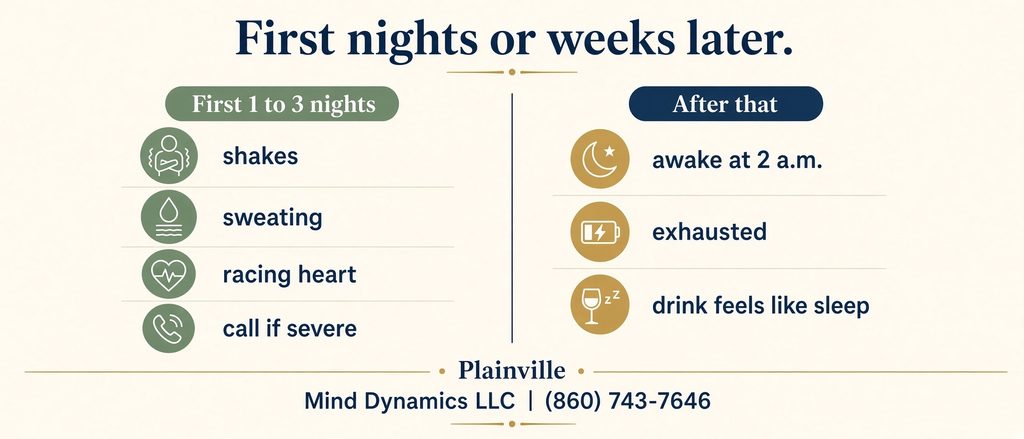
The first one to three nights
This can be withdrawal. Shakes. Sweat. A racing heart. Nausea. Dreams that feel too real. Waking every hour. If there is a history of seizures, or the person is confused, this is a medical night, not a sleep-hygiene night.
We wrote the safety line separately, on the alcohol withdrawal symptoms page. A seizure, confusion, a fever, or someone who cannot stay awake is 911. Shakes and no sleep, while still alert, can be assessed for outpatient detox in Plainville.
After the acute symptoms settle
This is the part people do not expect. The shakes are gone. The person is working again in Hartford or Farmington. And they still cannot sleep. They fall asleep at 11 and wake at 2. They lie there. By Thursday they are exhausted and the old solution is in the kitchen.
That stretch can last one week. It can last several. It is not proof that sobriety does not work. It is the nervous system catching up, and it is also anxiety, shame, and a house that got used to the person being numbed at night. Those are treatment problems.
Why people go back to the drink at night
The return is usually not a party. It is 1:17 a.m. and the person has been awake for two hours. They know one drink will knock them out. They also know what that drink starts. In the moment, sleep wins.
This is why willpower at midnight is a bad plan. The decision has to be made before the night, with a structure that is still there at 1 a.m. A meeting at 7 p.m. does not help if the person is alone with the ceiling at 2. Day treatment, a night plan, and someone who knows the pattern are what hold.
If the body is still in the acute window, start with outpatient detox in Plainville. If the acute window has passed and the nights are still broken, the next step is structured care, not another article about sleep tips.
What helps, and what does not
| What people try | What actually happens |
| One drink to sleep | You fall asleep. The night still breaks. Dependence continues. |
| Melatonin from the pharmacy, no plan | It may take the edge off. It does not treat withdrawal or anxiety. |
| Staying up until you collapse | You sleep from exhaustion. The next night is worse. |
| A dark room and no phone | Useful. Not enough if the nervous system is still in rebound. |
| Assessment, then PHP or IOP | Days have structure. Nights have a plan. Someone is watching the pattern. |
Sleep tips are fine. They are not a treatment for early recovery insomnia. A person who is shaking does not need a better pillow. A person three weeks sober who is awake every night needs the anxiety and the habit looked at, not a list of teas.
When the sleepless night is a reason to call
Call (860) 743-7646 if any of these are true.
You stopped or cut back and you cannot sleep, and the shakes or sweating are still there. You are drinking at night only to sleep. You have been sober for days or weeks and the 2 a.m. waking is pushing you back toward a drink. Someone at home is watching you pace the kitchen. You are a veteran or on TRICARE and you want this handled in Plainville, not across the state.
Do not call the clinic instead of 911 if there is a seizure, confusion, a fever, chest pain, or a person who cannot stay awake.
What care looks like after the acute night
Once someone is medically stable, the work is the day and the night. A partial hospitalization program gives a full treatment day and home at night. An intensive outpatient program is fewer hours and still structured. Both exist so the person is not alone with the 2 a.m. decision every night of the first month.
The PHP page and the
Anxiety and a low mood ride with the insomnia. We have already written about anxiety, depression, and relapse. If that page matches what the nights feel like, say so on the call. Sleep is often the surface. The feeling under it is what brings the drink back.
A spouse who is up with you is part of this. The family program is for the person who has been managing the nights and does not know whether to sit with you or leave you alone.
A night plan that is not a drink
This is not medical advice. It is the shape of a plan people can hold while they get assessed.
Same wake time, even after a bad night. No alcohol in the house if that is the agreement. Phone out of the bedroom. A short wind-down that does not include a drink, a work email, or a fight. Someone who knows you will text at 10, not at 2. If you are awake past a set time, you get up, you do not negotiate with the bottle, and you use the plan you wrote at 6 p.m. If shakes or confusion show up, the plan stops and you get medical help.
A plan on paper loses to a bottle if there is no care around it. The plan is a bridge to the clinic day. It is not the treatment.
Local note
Mind Dynamics is in Plainville. People come from Hartford, Bristol, New Britain, Farmington, Southington, West Hartford, Newington, Berlin, and Avon. You come in during the day. You sleep at home. If home is where the night breaks, that is a reason to say so on the call, not a reason to hide it.
Veterans can ask about the VA Community Care Network. TRICARE families can ask whether eligible outpatient care is authorized. Bring it up first so the plan matches the coverage.
What a broken night actually looks like
A Tuesday in Bristol. Work ran late. No drink, because the person said Monday was the stop. In bed at 10:30. Awake at 12:10. Heart fast. Sheets damp. They tell themselves it will pass. At 1:40 they are in the kitchen with the light off, doing the math on one beer. At 2:15 they are back in bed, angry, and the alarm is at 5:45 for the drive to Hartford.
A Saturday in Farmington. The house is quiet. The person has been sober for nine days. The acute shakes are gone. They still wake at 2. The spouse hears them. Neither of them knows if this is normal. By Sunday afternoon the person is short with everyone and the night feels like a threat instead of rest.
These are ordinary nights. They are also the nights people relapse, because the drink is a reliable sedative and the alternative is another hour awake. Naming the night is the point. If this is your kitchen, you are not unusual, and you do not have to solve it alone at 2 a.m.
What the brain is doing
Alcohol increases the brain’s calming signal and, over time, the brain reduces its own. Stop the alcohol and the calming signal drops while the alerting signal is still high. That is the wired, tired feeling. Heart rate stays up. Temperature regulation is off, which is why people sweat. Dream sleep rebounds, which is why the dreams feel too close.
None of that is a moral verdict. It is physiology. It also does not mean you should wait it out with no support. A brain in rebound plus a cabinet with alcohol in it is a setup. The setup is what treatment interrupts.
Sleep and the rest of early recovery
Bad sleep makes everything else harder. Cravings feel louder. A small comment from a spouse becomes a fight. Work in New Britain feels impossible. The person decides, wrongly, that sobriety is the problem, because the drinking nights at least ended.
This is one reason people feel stuck after the substance is gone. We wrote about why sobriety alone is not enough. Sleep is often the first place that shows up. The feeling under it, shame, anxiety, a life that still does not fit, is what the longer work is for.
A person who sleeps four broken hours will not do good therapy at 9 a.m. That is not a reason to skip care. It is a reason to tell the clinician the truth about the night, so the day is built around it instead of around a fantasy of a rested patient.
What to tell the person at home
If you live with someone who just stopped, the useful version is specific. Do not debate at 2 a.m. Do not offer a drink to calm them. Do not take their phone and lecture. Ask, once, whether they are shaking, confused, or only awake. Shaking or confusion means medical help. Awake and angry means the plan you agreed on in the evening, and a call to the clinic in the morning.
More on the family role is in how to support a loved one without enabling. The short version for this problem is: you are not their sleeping pill, and you are not their emergency department. You are the person who helps the night follow the plan.
Questions worth asking on the call
Is this still withdrawal, or is this early recovery insomnia? Should I be assessed for outpatient detox before we talk about sleep? What should the person at home do if I am awake and shaking? If I have been sober for two weeks and I still cannot sleep, is PHP or IOP the right next step? Can I keep working this week? Do you work with VA Community Care or TRICARE?
Questions people ask
How long until I sleep normally after quitting?
Some people improve in a few days. Some people are still waking at 2 a.m. after a few weeks. There is no honest single number. If it is pushing you back to a drink, do not wait for a number. Call.
Is this withdrawal or just insomnia?
If it is the first nights and you have shakes, sweat, or a racing heart, treat it as withdrawal until a clinician says otherwise. If the acute symptoms are gone and the waking remains, it is early recovery insomnia, often with anxiety. Both deserve a call. They are not the same emergency.
Can I take something over the counter?
Ask a clinician before you add a sleep aid, especially if you are still in withdrawal or you take other medication. A pharmacy bottle is not an assessment.
Will PHP or IOP fix my sleep?
They give the day structure and a place to work on the anxiety and the night pattern. They are not a sleeping pill. People sleep better when the day is held and the 2 a.m. decision is not theirs alone.
What if I only drink to sleep?
That is still dependence. The night is the trigger. It is a reason to call, not a smaller problem.
What we will not tell you
We will not give you a medication schedule. We will not say a nightcap is fine if it is only one. We will not say white-knuckling for thirty days is the treatment. We will not tell a teenager this page is for them. We will not promise you will sleep tonight if you call. We will tell you the night can be assessed, and that a plan exists for the mornings after.
If a page online tells you to taper with beer so you can sleep, close it. That is how the problem stays in the house.
The useful test is simple. If the only way the night ends is a drink, the night is part of the dependence. If the night is broken and the drink is already gone, the night is part of recovery, and it still deserves a plan. Either way, you do not have to invent the plan at 2 a.m.
If tonight is already the problem
You do not need another broken week to prove it. If you are in Plainville, Hartford, Bristol, or the towns around them, and you cannot sleep after stopping, call Mind Dynamics at (860) 743-7646. If the night includes a seizure, confusion, a fever, or someone who cannot stay awake, call 911. Sleep comes back. It comes back faster when the night is not a private emergency.
Start here if the symptoms are still acute: outpatient detox in Plainville. The phone is (860) 743-7646.