
Family support plays a meaningful role in addiction recovery by offering emotional stability, encouraging continued treatment, setting healthy boundaries, and helping rebuild trust. When families learn how to support without enabling, they create an environment that makes long-term recovery more sustainable.
Many people in Connecticut searching for addiction treatment are not only looking for help for the person using substances. They are also asking questions such as: How do I help a loved one with addiction? How can I support recovery without enabling? Should family members be involved in treatment? And how can trust be rebuilt after addiction?
At Mind Dynamics in Plainville, we see every day that addiction affects the whole family system. Our approach treats family work as a core part of recovery, not an optional add-on. The goal is not only sobriety. The goal is helping people build a more stable and meaningful life, and that work almost always involves the people closest to them.
How Does Addiction Affect the Family?
Addiction affects the entire family system. Relationships often become strained, trust can break down, and family members may experience fear, anger, guilt, or exhaustion. Over time, unhealthy patterns such as enabling or constant conflict can develop around the substance use.
When someone is deep in active addiction, the people closest to them usually change how they behave in response. Some become overly responsible. Others withdraw. Some try to control every detail. Others make excuses or cover up consequences. These responses are understandable, yet they often keep the family stuck in cycles that make recovery harder.
How Addiction Changes Family Relationships
Trust is one of the first things that suffers. Broken promises, secrecy, and unpredictable behavior erode the sense of safety that healthy relationships need. Family members may start walking on eggshells or constantly scanning for signs that something is wrong. Over time this creates chronic stress that affects physical health, sleep, work, and other relationships.
The Emotional Impact on Family Members
Partners, parents, children, and siblings can carry shame, resentment, and deep fatigue. Many report feeling like they have lost the person they once knew. Some develop their own anxiety or depression while trying to hold everything together. These patterns matter because recovery does not happen in isolation. The home environment, communication habits, and emotional climate all influence whether someone can maintain the changes they begin in treatment.
This is also why emotional healing after addiction is not only for the person who used substances. Family members often need their own space to process what they have lived through.
What Role Does Family Play in Addiction Recovery?
Family can influence recovery by providing emotional support, encouraging professional treatment, establishing healthy boundaries, improving communication, and creating a more stable environment. Family involvement works best when it supports the person’s recovery rather than trying to control it.
Emotional support means being present without constantly trying to fix or lecture. It means listening when the person is struggling and acknowledging progress without putting them on a pedestal. Accountability is different from control. It means being honest about the impact of past behavior and supporting the structure of treatment and recovery activities.
Healthy communication is one of the most powerful tools a family can develop. Many families have spent years in patterns of argument, silence, or crisis management. Learning to speak and listen differently creates space for real connection. Boundaries protect both the person in recovery and the rest of the family. They make clear what is acceptable and what is not, without needing to punish or abandon.
At Mind Dynamics we treat family involvement as part of the recovery process itself. This is built into our Level 2 work and into the broader LEAP Process and how it supports long-term recovery in Connecticut.
Can Family Support Help Prevent Relapse?
Family support can help reduce relapse risk when it decreases isolation, improves communication, encourages continued treatment, and creates accountability without control. Unresolved family conflict and emotional stress can make recovery more difficult.
Isolation is an important risk factor in recovery. When someone feels alone with their struggles, the old solutions become more tempting. A family that stays connected in healthy ways reduces that isolation. At the same time, high-conflict or highly stressful home environments can raise stress and may increase vulnerability to returning to substance use.
Recognizing early warning signs is another way families help. Changes in mood, sleep, isolation, or attitude often appear before a full return to use. Families who understand these signs can respond with concern rather than accusation and can encourage the person to reach out for support before things escalate.
The connection between family dynamics and relapse is one reason we wrote in detail about why people relapse after detox. Continuing care after detox, including family involvement, is often the difference between short-term sobriety and longer-term stability.
How Can You Support Someone Recovering From Addiction?
You can support someone in recovery by listening without immediately trying to fix everything, encouraging professional treatment, setting healthy boundaries, avoiding enabling behaviors, participating in family therapy when appropriate, learning about addiction, and taking care of your own wellbeing.
Listen Without Trying to Fix Everything
Many people in early recovery need to be heard more than they need advice. Listening builds trust and reduces the sense that every conversation will turn into a lecture or an argument.
Encourage Professional Treatment
Recovery is rarely sustained through willpower alone. Supporting connection to structured care makes a real difference, whether that is outpatient detox, PHP, IOP, or ongoing therapy.
Set Healthy Boundaries
Boundaries protect everyone. They are not punishments. They are clear agreements about what you will and will not accept. Consistent boundaries reduce chaos and help the person in recovery understand the real impact of their choices.
Avoid Enabling
Covering up consequences or removing the natural results of behavior often prolongs the problem. Enabling usually starts as an attempt to help or to reduce immediate pain, but over time it protects the addiction more than the person.
Participate in Family Therapy
Family therapy gives everyone tools to communicate better and rebuild damaged relationships. Support for loved ones is available through our family program in Connecticut.
Learn About Addiction and Recovery
Understanding that addiction is more than a series of bad choices helps reduce blame and increases compassion. Education also helps families recognize enabling patterns and warning signs more clearly.
Take Care of Your Own Wellbeing
You cannot support someone else from a place of constant depletion. Your own recovery as a family member matters. Rest, support, and honest conversation about your own limits are part of the process.
Stay Connected Without Becoming Controlling
Connection is helpful. Surveillance and control usually backfire. The goal is steady, respectful involvement rather than monitoring every move.
Supporting vs. Enabling: What’s the Difference?
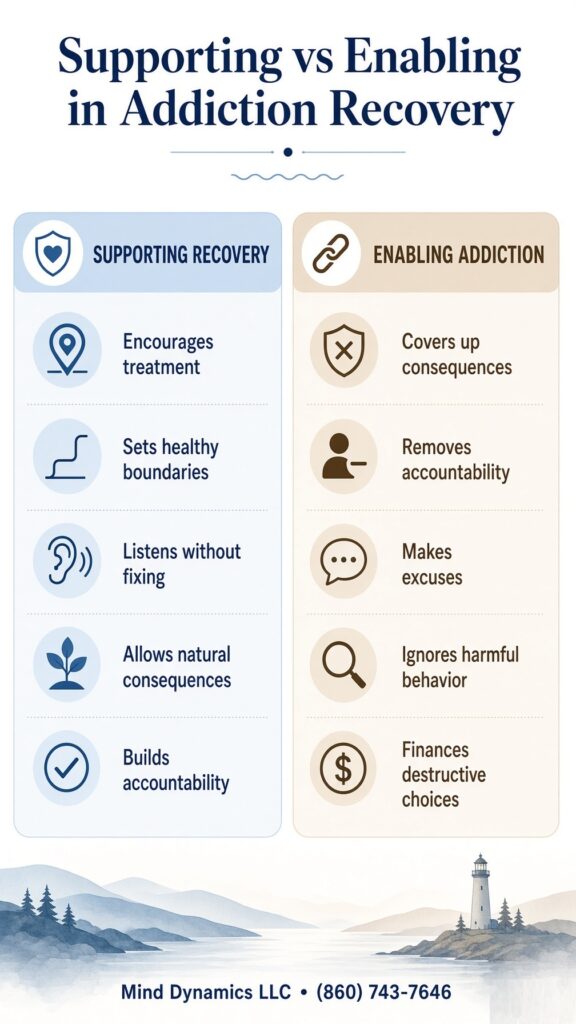
Supporting recovery means encouraging treatment, setting boundaries, and allowing natural consequences. Enabling often involves covering up consequences, making excuses, or removing the natural results of substance use.
The difference is not always obvious in the moment. Many enabling behaviors start as genuine attempts to help. Over time they protect the addiction more than the person. Learning to tell the difference is one of the most useful skills a family can develop.
| Supporting Recovery | Enabling Addiction |
| Encouraging treatment | Covering up consequences |
| Setting healthy boundaries | Removing every consequence |
| Listening and offering support | Ignoring harmful behavior |
| Encouraging accountability | Making excuses |
| Supporting healthy choices | Financing destructive choices |
This distinction is a core focus of our family program in Connecticut.
Why Family Therapy Can Matter in Addiction Recovery
Family therapy can help improve communication, rebuild trust, address conflict, teach healthy boundaries, and create a home environment that better supports recovery.
When only the person with the substance use disorder receives treatment, the family system often stays the same. Old patterns of communication, unspoken rules, and unresolved hurt remain in place. Family therapy brings those patterns into the open in a structured, guided way.
It helps family members understand addiction as a condition that affects thinking, behavior, and relationships rather than as pure moral failure. It gives people language for what they have been experiencing. It creates space to practice new ways of relating while still in the protective structure of treatment.
For many families in Connecticut, this work is the missing piece that makes outpatient treatment more effective. It turns recovery from an individual project into a shared process.
What If My Loved One Refuses Addiction Treatment?
One of the hardest situations for a family is wanting help for someone who does not believe they need treatment. Families cannot always force someone into meaningful long-term recovery, but they can change how they respond to the addiction.
This may include setting clear boundaries, stopping behaviors that enable substance use, seeking professional guidance for themselves, and keeping communication open when the person becomes willing to accept help. Many families find that changing their own responses creates more space for the person to eventually consider treatment.
Support for family members in this situation is available through our family program in Connecticut. You do not have to wait until the person is ready before getting help for yourself.
What Is Family Work at Mind Dynamics?
Mind Dynamics approaches family involvement as part of recovery itself. We do not treat it as an optional extra.
Our family program in Connecticut includes individual and family therapy, educational workshops, and support that helps families build healthier communication and clearer boundaries. The goal is to create a home environment that supports the changes the person is making in treatment rather than pulling against them.
This work sits inside our larger continuum of care and is guided by the same principles as the rest of our approach to recovery. We focus on practical skills, honest conversation, and sustainable change rather than quick fixes or blame.
How Family Support Fits Into Outpatient Addiction Treatment
Family involvement looks different at different levels of care, yet the principle stays the same: recovery is stronger when the people closest to the person are also learning and changing.
Family Support During PHP
During a Partial Hospitalization Program (PHP) in Connecticut, the days are structured and intensive. Family sessions can help the person and their loved ones stay aligned while the clinical work is at its most focused.
Family Support During IOP
In an Intensive Outpatient Program (IOP) in Connecticut, people are already balancing treatment with work or family responsibilities. Family involvement here often focuses on communication, boundaries, and support for the transition back into daily life.
Family Support During Outpatient Care
In traditional outpatient care the emphasis shifts toward longer-term maintenance of new patterns. Families who continue to practice what they learned in earlier stages help protect the progress that has been made. Across the entire continuum, family work reduces isolation and increases accountability in healthy ways. This is one reason we integrate family involvement into our addiction treatment in Connecticut rather than treating it as separate.
How Do You Rebuild Trust After Addiction?
Rebuilding trust after addiction takes time, consistency, honest communication, and follow-through on commitments. Actions matter more than promises.
Trust is not restored by a single conversation or a period of sobriety. It is rebuilt through repeated experiences of reliability. The person in recovery demonstrates change by doing what they say they will do, being transparent, and accepting that the family may still feel cautious.
Family members also have work to do. They need to allow space for change without demanding instant proof. They need to communicate their own needs and limits clearly. They need to notice and acknowledge real progress when it happens. This process is closely connected to emotional healing. Both the individual and the family are learning new ways of being in relationship. Patience and consistency are more useful than pressure.
What Should Families Avoid During Recovery?
Families should avoid constant monitoring, shaming, enabling, ignoring serious warning signs, trying to control every outcome, and neglecting their own wellbeing.
Constant monitoring often feels like safety to the family and like distrust to the person in recovery. Shaming may produce short-term compliance but usually increases secrecy and resentment. Enabling removes the natural feedback that helps people stay motivated for change. Ignoring warning signs leaves everyone unprepared. Trying to control every outcome is exhausting and usually impossible. Neglecting your own health and relationships leaves you with less capacity to offer steady support.
These patterns are common because they once served a purpose. In recovery they usually need to be replaced with clearer boundaries, better communication, and shared responsibility.
Frequently Asked Questions About Family and Addiction Recovery
What role does family play in addiction recovery?
Family can provide emotional support, encourage continued treatment, set healthy boundaries, improve communication, and help create a more stable environment. The most helpful role is supportive rather than controlling.
How can I help a family member who is struggling with addiction?
Encourage professional help, set clear boundaries, avoid enabling, listen without constant advice, and take care of your own wellbeing. Participating in family therapy when appropriate also helps.
Can family therapy help with addiction recovery?
Yes. Family therapy can improve communication, rebuild trust, address long-standing conflict, and teach skills that support recovery at home. Many families find it reduces the isolation and misunderstanding that make recovery harder.
Should family members be involved in addiction treatment?
Family involvement can be beneficial when it is clinically appropriate and consistent with the individual’s treatment plan. Structured family therapy and education can help loved ones understand addiction, improve communication, establish boundaries, and support recovery without taking control of the process.
What is the difference between supporting and enabling someone with addiction?
Supporting means encouraging treatment and healthy behavior while allowing natural consequences. Enabling means protecting the person from the results of their behavior in ways that make continued use easier.
Can I help my loved one with addiction without enabling them?
Yes. Supporting recovery means encouraging treatment, maintaining healthy boundaries, listening, and allowing natural consequences rather than covering up or repeatedly solving problems caused by substance use.
How can families rebuild trust after addiction?
Through consistent actions over time, honest communication, follow-through on commitments, and patience. Trust grows when words and behavior match repeatedly.
Can family conflict contribute to relapse?
Yes. High conflict, criticism, and unresolved tension increase stress and isolation, both of which can make recovery more difficult. Improving family patterns can reduce that risk.
What should I do if my loved one refuses addiction treatment?
You cannot force someone into lasting change. You can set boundaries that protect you, stop enabling, seek support for yourself, and keep the door open for when they become willing. Professional guidance for the family is often helpful in these situations.
What can families do when addiction is affecting the entire household?
Families can seek education and counseling, establish boundaries, improve communication, participate in family therapy when appropriate, and get support for themselves rather than trying to manage the addiction alone.
Does Mind Dynamics offer family support in Connecticut?
Yes. We offer structured family work as part of our outpatient programs in Plainville, serving individuals and families across Central Connecticut. You can learn more through our family program in Connecticut.
Key Takeaways
- Addiction affects the whole family system, not only the person using substances.
- Family support works best when it encourages treatment, sets boundaries, and avoids enabling.
- Healthy family involvement can reduce isolation and help lower relapse risk.
- Rebuilding trust takes consistent action over time from everyone involved.
- Family therapy and education give families practical tools they can use at home.
- Taking care of your own wellbeing is part of supporting someone else’s recovery.
Getting Support for Addiction Recovery in Connecticut
If you are a family member looking for practical ways to support a loved one, or if you are the person in recovery who wants your family involved in a healthy way, structured help is available.
Mind Dynamics is an outpatient addiction treatment program in Plainville, Connecticut. We serve individuals and families in Plainville and communities throughout Central Connecticut, including Hartford County, Bristol, Farmington, and New Britain.
Family involvement is built into our approach because we have seen that recovery is stronger when the people closest to the person are also learning and changing.
You can call us at (860) 743-7646 to ask questions, verify your insurance, or learn how family involvement fits into our outpatient programs. You can also explore our family program in Connecticut and our full range of outpatient addiction treatment options.
You do not have to figure this out alone. Support is available for both the person in recovery and the family around them.